HIRE

MKH 418 S MS microphone and principles of use
The MKH 418 S P48 U is an MS (mid-side) stereo microphone.
Its high degree of directivity makes it the ideal choice when recording stereo for ENG, film and television.
MS (mid-side) is an excellent stereo imaging technique because of its ability to vary the width of the stereo signal during recording or in post-production.
It has two independent acoustic capsules, a directional microphone for the M signal and a bi-directional (figure of eight) microphone for the S signal. These two different polar response microphones generate a stereo signal in an electrical matrix.
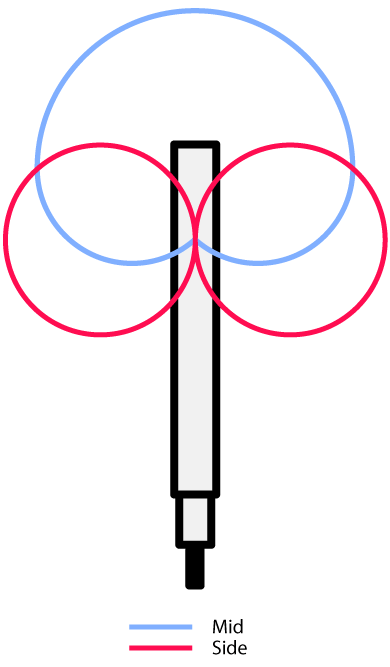
The M and S signals are available independently at the microphone output.
The MKH 418 S is designed for P48v powering. To ensure proper operation of the microphone, both channels always have to be powered simultaneously, even if only the signal of one channel is required
Notes on MS Stereo Sound Recording
The MS signal format of the MKH 418 S provides a particularly easy means of setting the optimum balance between the main information of the M channel and the spatial contribution of the S channel. This balancing can even be performed during re-processing without a loss of information if the original MS signals were recorded separately.
The MS signal format is converted into the XY format (ie: standard left/right stereo) by adding or subtracting the signals according to the principle X = M + S, Y = M – S. The proportion of the S signal influences the spatial effect and should be chosen in each case in accordance with the recording situation. In order to avoid restricting the possibilities of designing the sound impression, MS–XY matrixing in the microphone was not employed.
If a matrix circuit is not available on the mixing desk, matrixing can be performed using the 3-fader method.
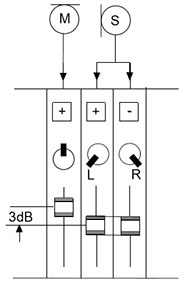
The M signal is connected to the first microphone channel and panned centre. The S signal is connected to the second channel and panned full left. Take an output from the second channel and connect to the third channel panned full right and phase reversed (via a phase reverse switch or via the cable). (To set the correct S signal level - set the pan controls of channel two to central, set the main fader to normal level and set the correct level at the preset. Then, set the pan control of channel 3 to centre, set the main fader to the same level as channel two and then adjust the pre-set of channel three until the signal totally disappears – the two channels are now set identical – now pan channel two fully left and channel three fully right for normal operation). Channels two and three are controlled as a single fader (mechanically or electrically coupled together). The stereo width is controlled by the relative levels – less side is a narrower image, more side is a wider image. The displacement of the faders by 3 dB, as shown in the diagram as an example, results in 1:1 ratio matrixing.
During matrixing, it should be taken into account that the direction of off-axis sound signals can be determined less and less at high frequencies due to the increasing directivity of the shotgun microphone. This may lead to diffused spatial effects, which can be desirable or undesirable depending on the recording situation. In case of doubt, the proportion of the S signal should not be chosen too high. In some cases, it might be necessary to reduce the treble in the S channel on the mixing console. At low frequencies below 300 Hz, it is very difficult to locate sounds for physiological reasons. Since the S system of the microphone, due to its design principle, is more sensitive than the M system to low-frequency interference caused for example by wind, the bass in the S channel should be reduced if required (e.g.: with a high-pass filter).
The microphone is positioned correctly when the word "TOP” is pointing upwards. If the microphone is mounted at 90° to this, i.e. in a vertical rather than horizontal plane, then a stereo recording will still be made but will be of the ground and the sky!
+44 (0)20 7482 0177
Opening hours Mon-Fri 9am to 5pm
(excluding public holidays)
Better Sound Ltd
